
Celebrating the Beauty and Power of Art

Our theme for 2027 will be announced towards the end of the year.
Journey through the intertwined narratives of individuals with lived experiences of persistent pain, researchers, clinicians, trainees, policymakers, and caregivers. Their hopes, needs, and dedicated efforts come alive in every piece. Through art, we don't merely promote understanding; we inspire action.
Note: Art allows each of us the opportunity to explore difficult topics in different ways. For this reason, some of the artworks on our online exhibition – or in the descriptions provided with them – touch on themes of end-of-life, mental health, nudity and human reproduction, and suffering that might be disturbing to some visitors.
.jpg)
Category Winner [2021]
Lady in Pain
Lizbeth Ayoub
She is one of us; a woman exposed to the invasive nature of pain. More women than men suffer from chronic pain. Chronic pain perseveres, overwhelms the body, mind and blurring one’s identity with oneself and society. Its dark web leaves one vulnerable, exposed, and subjected to its intensity. Yet, this lady stands tall, graceful in the face of adversity. Her golden head is a symbol of knowledge and future brain research for new treatments.

Category Winner [2021]
Like a Buzzing Mosquito, Chronic Pain is Impossible to Ignore.
Sandra Woods
This abstract mosquito represents the ever-present burden of chronic pain. If you’ve ever tried to fall asleep with a mosquito in your room, you know how distracting and even distressing it can seem!Chronic pain is much worse, buzzing its way into your mind and intruding in your thoughts. Pain makes it hard to concentrate at school, at work, or even on fun activities. Chronic pain can also be menacing, because we expect our bodies to use pain to tell us that something is wrong.
Appendicitis, kidney stones, labour pains – these kinds of pain signals are the body’s internal alarms, telling us to get medical help!
In chronic pain though, the body’s pain alarm stays on – all the time – even after any injury has healed, or sometimes for no obvious reason.
Not only is that mosquito buzzing around you all the time, imagine feeling that it is constantly biting you… when it isn’t.
Chronic pain is much worse than a mosquito bite, of course, but I’m sure you get the idea!
Even though we’d like to swat pain away, like a mosquito, much more research is needed to make that possible.
In the meantime, many people live with constant and long-term pain.
Like a menacing mosquito, hovering constantly over your head for months, years, or even decades

Category Winner [2022]
The Colors of the Pain Experience
Louise Castillo
Chronic pain colors many aspects of one’s life. It shades one’s work, relationships, and self-care, leading to suffering and for some, loss of employment, physical mobility, and identity.
Living with pain is emotionally stressful; some may feel trapped by their own thoughts and/or immersed in a cycle of avoidant behaviors with an aim to reduce their pain. Pain can limit a life previously known across the lifespan—an experience that can be devastatingly isolating. Yet, in the midst of that, many live through the daily peaks and pitfalls of the totality of the pain experience–experiencing a host of other emotions colored by strength and resilience in the face of adversity.

Category Winner [2022]
Displacement
Chloe Fleisher
I am a 13-year girl who has lived with chronic pain for more than 5 years. I drew this image to express how I sometimes feel when I'm in pain -like I am drowning or submerged. The pain consumes my whole body. I am helpless and there is nothing I can do to stop the suffering or to help myself.
Note: The art work was submitted by the parent of a child with chronic pain and medical complexity. The author of the art submission is her 13 year old daughter Chloe Fleisher

Category Winner [2022]
Turning to Stone
Terry Wilde
My late wife Lili Painted this in 2003 after full body Chronic Regional Pain Syndrome (CRPS) set in, triggered by a car accident in 1999. She had full-bodied Pain except in the left side of her face. At this point in her life she had no tolerated pain medications due to severe allergies. Suicide or Medically Assisted Death was a constant battle.
This Image depicts the struggle with pain and loss of ability, while showing the life in the left side of her face, the one place she could escape to. After many years of struggle and Healthcare Harm, she died in 2019 with a strong will to live.

First [2023]
Kept Hidden
Tarannum Rahnuma
My piece aims to capture the lived experiences of those with chronic pain, which affects approximately 1 in 5 Canadians. The daily struggle of managing chronic pain can make even the simplest tasks challenging, particularly in social situations where individuals may feel pressured to conceal their symptoms to avoid being stigmatized or perceived as a burden. My painting captures the emotional and physical toll of masking pain in social settings, particularly during happy occasions such as celebrations.
Through "Kept Hidden", I hope to foster greater empathy and understanding of the experiences of those living with chronic pain. I believe that by raising awareness and encouraging dialogue, we can create a more supportive and inclusive society that recognizes the challenges faced by those with pain.

First [2024]
Planting Seeds in the Wind
Ezinne Ekediegwu
Within this evocative artwork lies a profound narrative that encapsulates the enduring struggle of a patient suffering from endometriosis, whose existence is characterized by persistent pain and weakness. Through her poignant portrayal, the artist conveys the individual's unwavering commitment to raising awareness and fostering understanding of this debilitating disease within her challenging societal context.
The central figure, adorned in traditional Nigerian attire, serves as a poignant representation of the broader societal challenges faced by individuals grappling with endometriosis in Nigeria. The deep crimson hue of her garments symbolizes the profound suffering endured and perpetuated by the disease. With a hand firmly clasped to her abdomen, the locus of her anguish, she endeavours to scatter seeds into the wind. These seeds serve as potent symbols of her tireless efforts to sow awareness and enlightenment regarding her condition. Yet, the wind itself serves as a metaphor for the societal currents that buffet her efforts, for the prevailing ignorance and indifference that shroud endometriosis within her community.
Indeed, statistics reveal a staggering reality: one in ten women are afflicted by endometriosis, yet awareness remains alarmingly scarce. In Nigeria, the dearth of specialized medical practitioners exacerbates the plight, with no more than two Endometriosis specialists navigating the complex terrain of this condition. Globally, the paucity of knowledge and the absence of a definitive cure cast a shadow over the lives of countless individuals.
The tragic narrative continues with accounts of medical practitioners dismissing patients' symptoms as imaginary, prescribing ineffective treatments, and even subjecting sufferers to ridicule and mockery. Consequently, delayed diagnoses and preventable tragedies ensue, perpetuating a cycle of suffering and despair.
Yet, amidst the darkness, a beacon of hope emerges. Through her resolute advocacy and unwavering determination, the protagonist endeavours to illuminate the shadows shrouding endometriosis. Her indomitable spirit serves as a rallying cry, compelling society to confront its collective ignorance and apathy. Thus, through her courageous crusade, she endeavours to sow the seeds of awareness and understanding, nurturing a brighter future for generations to come.

First [2025]
Blooms on Neural Threads
Monika Kataria
This artwork represents the shared journey of people living with chronic pain and the caregivers, researchers, and clinicians who support them. The vibrant blooming flowers symbolize resilience and growth, while the small human figures seated within the petals capture deeply human moments of introspection and vulnerability experienced by people living with pain. The delicate neuron threads interwoven throughout highlight the vital role of researchers and medical professionals, whose efforts provide understanding, connection, and hope to those navigating pain. These threads nurture the blooms, reflecting the collective compassion and empathy that drives healing and progress. This piece celebrates the strength and humanity of those impacted by pain and the enduring power of unity.

First [2026]
Through the Darkness
Natalie Boivin
This is a watercolour illustrating a person impacted by pain. It depicts the affected person (dark blue footprints) walking in the snow, deep into the forest. The dark blue of the woods represents the fear and loneliness sometimes felt by the person living with pain. The vibrant red and orange represent the burning sensation often associated with pain. The sun is the wonderful aftermath when the pain dissipates. You will notice that the person ends up walking into the woods alone, however there are other foot (& paw) prints that represent the support that accompany the affected person for parts of the journey. The painting illustrates that the journey through pain is a myriad of things…it is dark, shared, lonely, and physically taxing. But most importantly, the painting shows a glimmer of hope as there is always a way through the darkness.

Second [2025]
Pain, Delirium, and the Jungle Within
Noor Al Kaabi
This artwork captures the visceral experience of pain and delirium in the intensive care unit (ICU). A woman lies in her hospital bed, her skin flushed red, symbolizing agony the body’s distress under illness and medical intervention. Her hair transforms into a dense and tangled jungle — her mind is both sanctuary and a nightmare.
Through this piece, I explore the delicate balance between alleviating suffering and the cognitive consequences of sedation. The question “What do I do for pain?” is not only personal but deeply ethical. Physicians are tasked with understanding the evolving landscape of pain management. Recent evidence favors multimodal pain relief strategies over excessive sedation to reduce ICU delirium and cognitive impairment. The historical reliance on benzodiazepines is waning, while non-pharmacologic interventions such as early mobility gain favour.
This piece invites the viewer to step into this complex intersection of medicine, ethics, and human vulnerability—where every decision carries consequences, and relief is often inseparable from consequences.

Second [2026]
Wrinkles of Time
Mohit Bhandari
Many live with pain--some, all of their lives. We may never know the extent of their suffering--but time tells all. The stories of millions of women around the world are told in their eyes--but even they can't hide the wrinkles of time---the tapestry of their life.

Third [2025]
Shackles of White Ribbon
Rimsha Malik
In "Shackles of White Ribbon", pain is both a constraint and a catalyst for resilience. The white ribbons—tight and restrictive—reflect the coping mechanisms and facades we adopt to contain pain, even when they confine our freedom and authenticity. Yet, within this restriction, there’s a quiet strength, as if these "shackles" keep the pieces from unraveling entirely.
The hand partially covering the face represents the instinct to shield oneself, to conceal the raw vulnerability that pain exposes. However, the piercing gaze challenges this, suggesting a confrontation with pain rather than retreat. The swirling background embodies the inner turmoil—waves of anguish and resilience intermingling—showing that pain is not a static experience but an ever-shifting force.
Through this self-portrait, pain is endured, hidden, battled, and ultimately embraced as part of oneself. The painting answers: what do I do for pain? I live with it, I confront it, and I transform it into art.

Third [2026]
How Do I Feel Pain? It's Complicated.
Meg Neufeld
I created this ceramic vessel after my twentieth surgery. When nerve weakness in my hand caused it to slip and break, I was devastated. What once symbolized perseverance echoed fragility. Repaired with gold, the vessel blooms into something new. Complementary paint colours mixed with sand reflect the discomfort and tolerance of chronic pain. Knotted strands of yarn show how opposite emotions coexist throughout the pain journey: we meet limits and exceed them while building resilience; we feel alone and find belonging by sharing stories; we grieve our former life and move forward courageously. How do I feel pain? It’s complicated.
Congratulations to our 2025 Winning Artists!
Unseen Struggles, Shared Horizons
Rangana Hetti Arachchige
“Unseen Struggles, Shared Horizons” is a visual journey through the hidden realities of chronic pain in Canada. From the relentless toll on trades workers to young adults lost in the transition between care systems, from aging bodies bearing decades of discomfort to the silent suffering of those without stable housing—pain is everywhere, yet too often ignored. Each image captures a moment of endurance, isolation, and resilience, reflecting the systemic gaps that leave many without adequate support. But pain is not just an individual experience; it is a shared reality that demands collective action. This collection invites viewers to see beyond the surface, to recognize the humanity in suffering, and to imagine a future where pain care is equitable and accessible for all. Through these images, I ask: What do we do for pain? And more importantly, what can we do together?
Unseen Struggles, Shared Horizons
Rangana Hetti Arachchige
“Unseen Struggles, Shared Horizons” is a visual journey through the hidden realities of chronic pain in Canada. From the relentless toll on trades workers to young adults lost in the transition between care systems, from aging bodies bearing decades of discomfort to the silent suffering of those without stable housing—pain is everywhere, yet too often ignored. Each image captures a moment of endurance, isolation, and resilience, reflecting the systemic gaps that leave many without adequate support. But pain is not just an individual experience; it is a shared reality that demands collective action. This collection invites viewers to see beyond the surface, to recognize the humanity in suffering, and to imagine a future where pain care is equitable and accessible for all. Through these images, I ask: What do we do for pain? And more importantly, what can we do together?
Unseen Struggles, Shared Horizons
Rangana Hetti Arachchige
“Unseen Struggles, Shared Horizons” is a visual journey through the hidden realities of chronic pain in Canada. From the relentless toll on trades workers to young adults lost in the transition between care systems, from aging bodies bearing decades of discomfort to the silent suffering of those without stable housing—pain is everywhere, yet too often ignored. Each image captures a moment of endurance, isolation, and resilience, reflecting the systemic gaps that leave many without adequate support. But pain is not just an individual experience; it is a shared reality that demands collective action. This collection invites viewers to see beyond the surface, to recognize the humanity in suffering, and to imagine a future where pain care is equitable and accessible for all. Through these images, I ask: What do we do for pain? And more importantly, what can we do together?
Unseen Struggles, Shared Horizons
Rangana Hetti Arachchige
“Unseen Struggles, Shared Horizons” is a visual journey through the hidden realities of chronic pain in Canada. From the relentless toll on trades workers to young adults lost in the transition between care systems, from aging bodies bearing decades of discomfort to the silent suffering of those without stable housing—pain is everywhere, yet too often ignored. Each image captures a moment of endurance, isolation, and resilience, reflecting the systemic gaps that leave many without adequate support. But pain is not just an individual experience; it is a shared reality that demands collective action. This collection invites viewers to see beyond the surface, to recognize the humanity in suffering, and to imagine a future where pain care is equitable and accessible for all. Through these images, I ask: What do we do for pain? And more importantly, what can we do together?
Unseen Struggles, Shared Horizons
Rangana Hetti Arachchige
“Unseen Struggles, Shared Horizons” is a visual journey through the hidden realities of chronic pain in Canada. From the relentless toll on trades workers to young adults lost in the transition between care systems, from aging bodies bearing decades of discomfort to the silent suffering of those without stable housing—pain is everywhere, yet too often ignored. Each image captures a moment of endurance, isolation, and resilience, reflecting the systemic gaps that leave many without adequate support. But pain is not just an individual experience; it is a shared reality that demands collective action. This collection invites viewers to see beyond the surface, to recognize the humanity in suffering, and to imagine a future where pain care is equitable and accessible for all. Through these images, I ask: What do we do for pain? And more importantly, what can we do together?
Unseen Struggles, Shared Horizons
Rangana Hetti Arachchige
“Unseen Struggles, Shared Horizons” is a visual journey through the hidden realities of chronic pain in Canada. From the relentless toll on trades workers to young adults lost in the transition between care systems, from aging bodies bearing decades of discomfort to the silent suffering of those without stable housing—pain is everywhere, yet too often ignored. Each image captures a moment of endurance, isolation, and resilience, reflecting the systemic gaps that leave many without adequate support. But pain is not just an individual experience; it is a shared reality that demands collective action. This collection invites viewers to see beyond the surface, to recognize the humanity in suffering, and to imagine a future where pain care is equitable and accessible for all. Through these images, I ask: What do we do for pain? And more importantly, what can we do together?
Unseen Struggles, Shared Horizons
Rangana Hetti Arachchige
“Unseen Struggles, Shared Horizons” is a visual journey through the hidden realities of chronic pain in Canada. From the relentless toll on trades workers to young adults lost in the transition between care systems, from aging bodies bearing decades of discomfort to the silent suffering of those without stable housing—pain is everywhere, yet too often ignored. Each image captures a moment of endurance, isolation, and resilience, reflecting the systemic gaps that leave many without adequate support. But pain is not just an individual experience; it is a shared reality that demands collective action. This collection invites viewers to see beyond the surface, to recognize the humanity in suffering, and to imagine a future where pain care is equitable and accessible for all. Through these images, I ask: What do we do for pain? And more importantly, what can we do together?
Unseen Struggles, Shared Horizons
Rangana Hetti Arachchige
“Unseen Struggles, Shared Horizons” is a visual journey through the hidden realities of chronic pain in Canada. From the relentless toll on trades workers to young adults lost in the transition between care systems, from aging bodies bearing decades of discomfort to the silent suffering of those without stable housing—pain is everywhere, yet too often ignored. Each image captures a moment of endurance, isolation, and resilience, reflecting the systemic gaps that leave many without adequate support. But pain is not just an individual experience; it is a shared reality that demands collective action. This collection invites viewers to see beyond the surface, to recognize the humanity in suffering, and to imagine a future where pain care is equitable and accessible for all. Through these images, I ask: What do we do for pain? And more importantly, what can we do together?
Unseen Struggles, Shared Horizons
Rangana Hetti Arachchige
“Unseen Struggles, Shared Horizons” is a visual journey through the hidden realities of chronic pain in Canada. From the relentless toll on trades workers to young adults lost in the transition between care systems, from aging bodies bearing decades of discomfort to the silent suffering of those without stable housing—pain is everywhere, yet too often ignored. Each image captures a moment of endurance, isolation, and resilience, reflecting the systemic gaps that leave many without adequate support. But pain is not just an individual experience; it is a shared reality that demands collective action. This collection invites viewers to see beyond the surface, to recognize the humanity in suffering, and to imagine a future where pain care is equitable and accessible for all. Through these images, I ask: What do we do for pain? And more importantly, what can we do together?
Unseen Struggles, Shared Horizons
Rangana Hetti Arachchige
“Unseen Struggles, Shared Horizons” is a visual journey through the hidden realities of chronic pain in Canada. From the relentless toll on trades workers to young adults lost in the transition between care systems, from aging bodies bearing decades of discomfort to the silent suffering of those without stable housing—pain is everywhere, yet too often ignored. Each image captures a moment of endurance, isolation, and resilience, reflecting the systemic gaps that leave many without adequate support. But pain is not just an individual experience; it is a shared reality that demands collective action. This collection invites viewers to see beyond the surface, to recognize the humanity in suffering, and to imagine a future where pain care is equitable and accessible for all. Through these images, I ask: What do we do for pain? And more importantly, what can we do together?
Unseen Struggles, Shared Horizons
Rangana Hetti Arachchige
“Unseen Struggles, Shared Horizons” is a visual journey through the hidden realities of chronic pain in Canada. From the relentless toll on trades workers to young adults lost in the transition between care systems, from aging bodies bearing decades of discomfort to the silent suffering of those without stable housing—pain is everywhere, yet too often ignored. Each image captures a moment of endurance, isolation, and resilience, reflecting the systemic gaps that leave many without adequate support. But pain is not just an individual experience; it is a shared reality that demands collective action. This collection invites viewers to see beyond the surface, to recognize the humanity in suffering, and to imagine a future where pain care is equitable and accessible for all. Through these images, I ask: What do we do for pain? And more importantly, what can we do together?
Unseen Struggles, Shared Horizons
Rangana Hetti Arachchige
“Unseen Struggles, Shared Horizons” is a visual journey through the hidden realities of chronic pain in Canada. From the relentless toll on trades workers to young adults lost in the transition between care systems, from aging bodies bearing decades of discomfort to the silent suffering of those without stable housing—pain is everywhere, yet too often ignored. Each image captures a moment of endurance, isolation, and resilience, reflecting the systemic gaps that leave many without adequate support. But pain is not just an individual experience; it is a shared reality that demands collective action. This collection invites viewers to see beyond the surface, to recognize the humanity in suffering, and to imagine a future where pain care is equitable and accessible for all. Through these images, I ask: What do we do for pain? And more importantly, what can we do together?
Unseen Struggles, Shared Horizons
Rangana Hetti Arachchige
“Unseen Struggles, Shared Horizons” is a visual journey through the hidden realities of chronic pain in Canada. From the relentless toll on trades workers to young adults lost in the transition between care systems, from aging bodies bearing decades of discomfort to the silent suffering of those without stable housing—pain is everywhere, yet too often ignored. Each image captures a moment of endurance, isolation, and resilience, reflecting the systemic gaps that leave many without adequate support. But pain is not just an individual experience; it is a shared reality that demands collective action. This collection invites viewers to see beyond the surface, to recognize the humanity in suffering, and to imagine a future where pain care is equitable and accessible for all. Through these images, I ask: What do we do for pain? And more importantly, what can we do together?
Unseen Struggles, Shared Horizons
Rangana Hetti Arachchige
“Unseen Struggles, Shared Horizons” is a visual journey through the hidden realities of chronic pain in Canada. From the relentless toll on trades workers to young adults lost in the transition between care systems, from aging bodies bearing decades of discomfort to the silent suffering of those without stable housing—pain is everywhere, yet too often ignored. Each image captures a moment of endurance, isolation, and resilience, reflecting the systemic gaps that leave many without adequate support. But pain is not just an individual experience; it is a shared reality that demands collective action. This collection invites viewers to see beyond the surface, to recognize the humanity in suffering, and to imagine a future where pain care is equitable and accessible for all. Through these images, I ask: What do we do for pain? And more importantly, what can we do together?
Unseen Struggles, Shared Horizons
Rangana Hetti Arachchige
“Unseen Struggles, Shared Horizons” is a visual journey through the hidden realities of chronic pain in Canada. From the relentless toll on trades workers to young adults lost in the transition between care systems, from aging bodies bearing decades of discomfort to the silent suffering of those without stable housing—pain is everywhere, yet too often ignored. Each image captures a moment of endurance, isolation, and resilience, reflecting the systemic gaps that leave many without adequate support. But pain is not just an individual experience; it is a shared reality that demands collective action. This collection invites viewers to see beyond the surface, to recognize the humanity in suffering, and to imagine a future where pain care is equitable and accessible for all. Through these images, I ask: What do we do for pain? And more importantly, what can we do together?
Unseen Struggles, Shared Horizons
Rangana Hetti Arachchige
“Unseen Struggles, Shared Horizons” is a visual journey through the hidden realities of chronic pain in Canada. From the relentless toll on trades workers to young adults lost in the transition between care systems, from aging bodies bearing decades of discomfort to the silent suffering of those without stable housing—pain is everywhere, yet too often ignored. Each image captures a moment of endurance, isolation, and resilience, reflecting the systemic gaps that leave many without adequate support. But pain is not just an individual experience; it is a shared reality that demands collective action. This collection invites viewers to see beyond the surface, to recognize the humanity in suffering, and to imagine a future where pain care is equitable and accessible for all. Through these images, I ask: What do we do for pain? And more importantly, what can we do together?
Unseen Struggles, Shared Horizons
Rangana Hetti Arachchige
“Unseen Struggles, Shared Horizons” is a visual journey through the hidden realities of chronic pain in Canada. From the relentless toll on trades workers to young adults lost in the transition between care systems, from aging bodies bearing decades of discomfort to the silent suffering of those without stable housing—pain is everywhere, yet too often ignored. Each image captures a moment of endurance, isolation, and resilience, reflecting the systemic gaps that leave many without adequate support. But pain is not just an individual experience; it is a shared reality that demands collective action. This collection invites viewers to see beyond the surface, to recognize the humanity in suffering, and to imagine a future where pain care is equitable and accessible for all. Through these images, I ask: What do we do for pain? And more importantly, what can we do together?
Unseen Struggles, Shared Horizons
Rangana Hetti Arachchige
“Unseen Struggles, Shared Horizons” is a visual journey through the hidden realities of chronic pain in Canada. From the relentless toll on trades workers to young adults lost in the transition between care systems, from aging bodies bearing decades of discomfort to the silent suffering of those without stable housing—pain is everywhere, yet too often ignored. Each image captures a moment of endurance, isolation, and resilience, reflecting the systemic gaps that leave many without adequate support. But pain is not just an individual experience; it is a shared reality that demands collective action. This collection invites viewers to see beyond the surface, to recognize the humanity in suffering, and to imagine a future where pain care is equitable and accessible for all. Through these images, I ask: What do we do for pain? And more importantly, what can we do together?
Unseen Struggles, Shared Horizons
Rangana Hetti Arachchige
“Unseen Struggles, Shared Horizons” is a visual journey through the hidden realities of chronic pain in Canada. From the relentless toll on trades workers to young adults lost in the transition between care systems, from aging bodies bearing decades of discomfort to the silent suffering of those without stable housing—pain is everywhere, yet too often ignored. Each image captures a moment of endurance, isolation, and resilience, reflecting the systemic gaps that leave many without adequate support. But pain is not just an individual experience; it is a shared reality that demands collective action. This collection invites viewers to see beyond the surface, to recognize the humanity in suffering, and to imagine a future where pain care is equitable and accessible for all. Through these images, I ask: What do we do for pain? And more importantly, what can we do together?
Unseen Struggles, Shared Horizons
Rangana Hetti Arachchige
“Unseen Struggles, Shared Horizons” is a visual journey through the hidden realities of chronic pain in Canada. From the relentless toll on trades workers to young adults lost in the transition between care systems, from aging bodies bearing decades of discomfort to the silent suffering of those without stable housing—pain is everywhere, yet too often ignored. Each image captures a moment of endurance, isolation, and resilience, reflecting the systemic gaps that leave many without adequate support. But pain is not just an individual experience; it is a shared reality that demands collective action. This collection invites viewers to see beyond the surface, to recognize the humanity in suffering, and to imagine a future where pain care is equitable and accessible for all. Through these images, I ask: What do we do for pain? And more importantly, what can we do together?
Unseen Struggles, Shared Horizons
Rangana Hetti Arachchige
“Unseen Struggles, Shared Horizons” is a visual journey through the hidden realities of chronic pain in Canada. From the relentless toll on trades workers to young adults lost in the transition between care systems, from aging bodies bearing decades of discomfort to the silent suffering of those without stable housing—pain is everywhere, yet too often ignored. Each image captures a moment of endurance, isolation, and resilience, reflecting the systemic gaps that leave many without adequate support. But pain is not just an individual experience; it is a shared reality that demands collective action. This collection invites viewers to see beyond the surface, to recognize the humanity in suffering, and to imagine a future where pain care is equitable and accessible for all. Through these images, I ask: What do we do for pain? And more importantly, what can we do together?
Unseen Struggles, Shared Horizons
Rangana Hetti Arachchige
“Unseen Struggles, Shared Horizons” is a visual journey through the hidden realities of chronic pain in Canada. From the relentless toll on trades workers to young adults lost in the transition between care systems, from aging bodies bearing decades of discomfort to the silent suffering of those without stable housing—pain is everywhere, yet too often ignored. Each image captures a moment of endurance, isolation, and resilience, reflecting the systemic gaps that leave many without adequate support. But pain is not just an individual experience; it is a shared reality that demands collective action. This collection invites viewers to see beyond the surface, to recognize the humanity in suffering, and to imagine a future where pain care is equitable and accessible for all. Through these images, I ask: What do we do for pain? And more importantly, what can we do together?
Unseen Struggles, Shared Horizons
Rangana Hetti Arachchige
“Unseen Struggles, Shared Horizons” is a visual journey through the hidden realities of chronic pain in Canada. From the relentless toll on trades workers to young adults lost in the transition between care systems, from aging bodies bearing decades of discomfort to the silent suffering of those without stable housing—pain is everywhere, yet too often ignored. Each image captures a moment of endurance, isolation, and resilience, reflecting the systemic gaps that leave many without adequate support. But pain is not just an individual experience; it is a shared reality that demands collective action. This collection invites viewers to see beyond the surface, to recognize the humanity in suffering, and to imagine a future where pain care is equitable and accessible for all. Through these images, I ask: What do we do for pain? And more importantly, what can we do together?
Unseen Struggles, Shared Horizons
Rangana Hetti Arachchige
“Unseen Struggles, Shared Horizons” is a visual journey through the hidden realities of chronic pain in Canada. From the relentless toll on trades workers to young adults lost in the transition between care systems, from aging bodies bearing decades of discomfort to the silent suffering of those without stable housing—pain is everywhere, yet too often ignored. Each image captures a moment of endurance, isolation, and resilience, reflecting the systemic gaps that leave many without adequate support. But pain is not just an individual experience; it is a shared reality that demands collective action. This collection invites viewers to see beyond the surface, to recognize the humanity in suffering, and to imagine a future where pain care is equitable and accessible for all. Through these images, I ask: What do we do for pain? And more importantly, what can we do together?
Unseen Struggles, Shared Horizons
Rangana Hetti Arachchige
“Unseen Struggles, Shared Horizons” is a visual journey through the hidden realities of chronic pain in Canada. From the relentless toll on trades workers to young adults lost in the transition between care systems, from aging bodies bearing decades of discomfort to the silent suffering of those without stable housing—pain is everywhere, yet too often ignored. Each image captures a moment of endurance, isolation, and resilience, reflecting the systemic gaps that leave many without adequate support. But pain is not just an individual experience; it is a shared reality that demands collective action. This collection invites viewers to see beyond the surface, to recognize the humanity in suffering, and to imagine a future where pain care is equitable and accessible for all. Through these images, I ask: What do we do for pain? And more importantly, what can we do together?
Unseen Struggles, Shared Horizons
Rangana Hetti Arachchige
“Unseen Struggles, Shared Horizons” is a visual journey through the hidden realities of chronic pain in Canada. From the relentless toll on trades workers to young adults lost in the transition between care systems, from aging bodies bearing decades of discomfort to the silent suffering of those without stable housing—pain is everywhere, yet too often ignored. Each image captures a moment of endurance, isolation, and resilience, reflecting the systemic gaps that leave many without adequate support. But pain is not just an individual experience; it is a shared reality that demands collective action. This collection invites viewers to see beyond the surface, to recognize the humanity in suffering, and to imagine a future where pain care is equitable and accessible for all. Through these images, I ask: What do we do for pain? And more importantly, what can we do together?
Unseen Struggles, Shared Horizons
Rangana Hetti Arachchige
“Unseen Struggles, Shared Horizons” is a visual journey through the hidden realities of chronic pain in Canada. From the relentless toll on trades workers to young adults lost in the transition between care systems, from aging bodies bearing decades of discomfort to the silent suffering of those without stable housing—pain is everywhere, yet too often ignored. Each image captures a moment of endurance, isolation, and resilience, reflecting the systemic gaps that leave many without adequate support. But pain is not just an individual experience; it is a shared reality that demands collective action. This collection invites viewers to see beyond the surface, to recognize the humanity in suffering, and to imagine a future where pain care is equitable and accessible for all. Through these images, I ask: What do we do for pain? And more importantly, what can we do together?
Unseen Struggles, Shared Horizons
Rangana Hetti Arachchige
“Unseen Struggles, Shared Horizons” is a visual journey through the hidden realities of chronic pain in Canada. From the relentless toll on trades workers to young adults lost in the transition between care systems, from aging bodies bearing decades of discomfort to the silent suffering of those without stable housing—pain is everywhere, yet too often ignored. Each image captures a moment of endurance, isolation, and resilience, reflecting the systemic gaps that leave many without adequate support. But pain is not just an individual experience; it is a shared reality that demands collective action. This collection invites viewers to see beyond the surface, to recognize the humanity in suffering, and to imagine a future where pain care is equitable and accessible for all. Through these images, I ask: What do we do for pain? And more importantly, what can we do together?
Unseen Struggles, Shared Horizons
Rangana Hetti Arachchige
“Unseen Struggles, Shared Horizons” is a visual journey through the hidden realities of chronic pain in Canada. From the relentless toll on trades workers to young adults lost in the transition between care systems, from aging bodies bearing decades of discomfort to the silent suffering of those without stable housing—pain is everywhere, yet too often ignored. Each image captures a moment of endurance, isolation, and resilience, reflecting the systemic gaps that leave many without adequate support. But pain is not just an individual experience; it is a shared reality that demands collective action. This collection invites viewers to see beyond the surface, to recognize the humanity in suffering, and to imagine a future where pain care is equitable and accessible for all. Through these images, I ask: What do we do for pain? And more importantly, what can we do together?
Unseen Struggles, Shared Horizons
Rangana Hetti Arachchige
“Unseen Struggles, Shared Horizons” is a visual journey through the hidden realities of chronic pain in Canada. From the relentless toll on trades workers to young adults lost in the transition between care systems, from aging bodies bearing decades of discomfort to the silent suffering of those without stable housing—pain is everywhere, yet too often ignored. Each image captures a moment of endurance, isolation, and resilience, reflecting the systemic gaps that leave many without adequate support. But pain is not just an individual experience; it is a shared reality that demands collective action. This collection invites viewers to see beyond the surface, to recognize the humanity in suffering, and to imagine a future where pain care is equitable and accessible for all. Through these images, I ask: What do we do for pain? And more importantly, what can we do together?
Unseen Struggles, Shared Horizons
Rangana Hetti Arachchige
“Unseen Struggles, Shared Horizons” is a visual journey through the hidden realities of chronic pain in Canada. From the relentless toll on trades workers to young adults lost in the transition between care systems, from aging bodies bearing decades of discomfort to the silent suffering of those without stable housing—pain is everywhere, yet too often ignored. Each image captures a moment of endurance, isolation, and resilience, reflecting the systemic gaps that leave many without adequate support. But pain is not just an individual experience; it is a shared reality that demands collective action. This collection invites viewers to see beyond the surface, to recognize the humanity in suffering, and to imagine a future where pain care is equitable and accessible for all. Through these images, I ask: What do we do for pain? And more importantly, what can we do together?
Unseen Struggles, Shared Horizons
Rangana Hetti Arachchige
“Unseen Struggles, Shared Horizons” is a visual journey through the hidden realities of chronic pain in Canada. From the relentless toll on trades workers to young adults lost in the transition between care systems, from aging bodies bearing decades of discomfort to the silent suffering of those without stable housing—pain is everywhere, yet too often ignored. Each image captures a moment of endurance, isolation, and resilience, reflecting the systemic gaps that leave many without adequate support. But pain is not just an individual experience; it is a shared reality that demands collective action. This collection invites viewers to see beyond the surface, to recognize the humanity in suffering, and to imagine a future where pain care is equitable and accessible for all. Through these images, I ask: What do we do for pain? And more importantly, what can we do together?
Unseen Struggles, Shared Horizons
Rangana Hetti Arachchige
“Unseen Struggles, Shared Horizons” is a visual journey through the hidden realities of chronic pain in Canada. From the relentless toll on trades workers to young adults lost in the transition between care systems, from aging bodies bearing decades of discomfort to the silent suffering of those without stable housing—pain is everywhere, yet too often ignored. Each image captures a moment of endurance, isolation, and resilience, reflecting the systemic gaps that leave many without adequate support. But pain is not just an individual experience; it is a shared reality that demands collective action. This collection invites viewers to see beyond the surface, to recognize the humanity in suffering, and to imagine a future where pain care is equitable and accessible for all. Through these images, I ask: What do we do for pain? And more importantly, what can we do together?
Unseen Struggles, Shared Horizons
Rangana Hetti Arachchige
“Unseen Struggles, Shared Horizons” is a visual journey through the hidden realities of chronic pain in Canada. From the relentless toll on trades workers to young adults lost in the transition between care systems, from aging bodies bearing decades of discomfort to the silent suffering of those without stable housing—pain is everywhere, yet too often ignored. Each image captures a moment of endurance, isolation, and resilience, reflecting the systemic gaps that leave many without adequate support. But pain is not just an individual experience; it is a shared reality that demands collective action. This collection invites viewers to see beyond the surface, to recognize the humanity in suffering, and to imagine a future where pain care is equitable and accessible for all. Through these images, I ask: What do we do for pain? And more importantly, what can we do together?
Unseen Struggles, Shared Horizons
Rangana Hetti Arachchige
“Unseen Struggles, Shared Horizons” is a visual journey through the hidden realities of chronic pain in Canada. From the relentless toll on trades workers to young adults lost in the transition between care systems, from aging bodies bearing decades of discomfort to the silent suffering of those without stable housing—pain is everywhere, yet too often ignored. Each image captures a moment of endurance, isolation, and resilience, reflecting the systemic gaps that leave many without adequate support. But pain is not just an individual experience; it is a shared reality that demands collective action. This collection invites viewers to see beyond the surface, to recognize the humanity in suffering, and to imagine a future where pain care is equitable and accessible for all. Through these images, I ask: What do we do for pain? And more importantly, what can we do together?
Unseen Struggles, Shared Horizons
Rangana Hetti Arachchige
“Unseen Struggles, Shared Horizons” is a visual journey through the hidden realities of chronic pain in Canada. From the relentless toll on trades workers to young adults lost in the transition between care systems, from aging bodies bearing decades of discomfort to the silent suffering of those without stable housing—pain is everywhere, yet too often ignored. Each image captures a moment of endurance, isolation, and resilience, reflecting the systemic gaps that leave many without adequate support. But pain is not just an individual experience; it is a shared reality that demands collective action. This collection invites viewers to see beyond the surface, to recognize the humanity in suffering, and to imagine a future where pain care is equitable and accessible for all. Through these images, I ask: What do we do for pain? And more importantly, what can we do together?
Unseen Struggles, Shared Horizons
Rangana Hetti Arachchige
“Unseen Struggles, Shared Horizons” is a visual journey through the hidden realities of chronic pain in Canada. From the relentless toll on trades workers to young adults lost in the transition between care systems, from aging bodies bearing decades of discomfort to the silent suffering of those without stable housing—pain is everywhere, yet too often ignored. Each image captures a moment of endurance, isolation, and resilience, reflecting the systemic gaps that leave many without adequate support. But pain is not just an individual experience; it is a shared reality that demands collective action. This collection invites viewers to see beyond the surface, to recognize the humanity in suffering, and to imagine a future where pain care is equitable and accessible for all. Through these images, I ask: What do we do for pain? And more importantly, what can we do together?
Unseen Struggles, Shared Horizons
Rangana Hetti Arachchige
“Unseen Struggles, Shared Horizons” is a visual journey through the hidden realities of chronic pain in Canada. From the relentless toll on trades workers to young adults lost in the transition between care systems, from aging bodies bearing decades of discomfort to the silent suffering of those without stable housing—pain is everywhere, yet too often ignored. Each image captures a moment of endurance, isolation, and resilience, reflecting the systemic gaps that leave many without adequate support. But pain is not just an individual experience; it is a shared reality that demands collective action. This collection invites viewers to see beyond the surface, to recognize the humanity in suffering, and to imagine a future where pain care is equitable and accessible for all. Through these images, I ask: What do we do for pain? And more importantly, what can we do together?
Unseen Struggles, Shared Horizons
Rangana Hetti Arachchige
“Unseen Struggles, Shared Horizons” is a visual journey through the hidden realities of chronic pain in Canada. From the relentless toll on trades workers to young adults lost in the transition between care systems, from aging bodies bearing decades of discomfort to the silent suffering of those without stable housing—pain is everywhere, yet too often ignored. Each image captures a moment of endurance, isolation, and resilience, reflecting the systemic gaps that leave many without adequate support. But pain is not just an individual experience; it is a shared reality that demands collective action. This collection invites viewers to see beyond the surface, to recognize the humanity in suffering, and to imagine a future where pain care is equitable and accessible for all. Through these images, I ask: What do we do for pain? And more importantly, what can we do together?
Unseen Struggles, Shared Horizons
Rangana Hetti Arachchige
“Unseen Struggles, Shared Horizons” is a visual journey through the hidden realities of chronic pain in Canada. From the relentless toll on trades workers to young adults lost in the transition between care systems, from aging bodies bearing decades of discomfort to the silent suffering of those without stable housing—pain is everywhere, yet too often ignored. Each image captures a moment of endurance, isolation, and resilience, reflecting the systemic gaps that leave many without adequate support. But pain is not just an individual experience; it is a shared reality that demands collective action. This collection invites viewers to see beyond the surface, to recognize the humanity in suffering, and to imagine a future where pain care is equitable and accessible for all. Through these images, I ask: What do we do for pain? And more importantly, what can we do together?
Unseen Struggles, Shared Horizons
Rangana Hetti Arachchige
“Unseen Struggles, Shared Horizons” is a visual journey through the hidden realities of chronic pain in Canada. From the relentless toll on trades workers to young adults lost in the transition between care systems, from aging bodies bearing decades of discomfort to the silent suffering of those without stable housing—pain is everywhere, yet too often ignored. Each image captures a moment of endurance, isolation, and resilience, reflecting the systemic gaps that leave many without adequate support. But pain is not just an individual experience; it is a shared reality that demands collective action. This collection invites viewers to see beyond the surface, to recognize the humanity in suffering, and to imagine a future where pain care is equitable and accessible for all. Through these images, I ask: What do we do for pain? And more importantly, what can we do together?
Unseen Struggles, Shared Horizons
Rangana Hetti Arachchige
“Unseen Struggles, Shared Horizons” is a visual journey through the hidden realities of chronic pain in Canada. From the relentless toll on trades workers to young adults lost in the transition between care systems, from aging bodies bearing decades of discomfort to the silent suffering of those without stable housing—pain is everywhere, yet too often ignored. Each image captures a moment of endurance, isolation, and resilience, reflecting the systemic gaps that leave many without adequate support. But pain is not just an individual experience; it is a shared reality that demands collective action. This collection invites viewers to see beyond the surface, to recognize the humanity in suffering, and to imagine a future where pain care is equitable and accessible for all. Through these images, I ask: What do we do for pain? And more importantly, what can we do together?
Members vote for our 2026 art award winners until May 1st, 2026. Interested in joining? Become a member of the Canadian Pain Society.
Meg Neufeld
How Do I Feel Pain? It's Complicated.
Ceramic fragments integrated with acrylic paint, sand, yarn and gold leaf on wood panel.
I created this ceramic vessel after my twentieth surgery. When nerve weakness in my hand caused it to slip and break, I was devastated. What once symbolized perseverance echoed fragility. Repaired with gold, the vessel blooms into something new. Complementary paint colours mixed with sand reflect the discomfort and tolerance of chronic pain. Knotted strands of yarn show how opposite emotions coexist throughout the pain journey: we meet limits and exceed them while building resilience; we feel alone and find belonging by sharing stories; we grieve our former life and move forward courageously. How do I feel pain? It’s complicated.
Mohit Bhandari
Wrinkles of Time
Pencil Sketch.
Many live with pain--some, all of their lives. We may never know the extent of their suffering--but time tells all. The stories of millions of women around the world are told in their eyes--but even they can't hide the wrinkles of time---the tapestry of their life.
Natalie Boivin
Through the Darkness
Watercolour on 300 gsm paper
This is a watercolour illustrating a person impacted by pain. It depicts the affected person (dark blue footprints) walking in the snow, deep into the forest. The dark blue of the woods represents the fear and loneliness sometimes felt by the person living with pain. The vibrant red and orange represent the burning sensation often associated with pain. The sun is the wonderful aftermath when the pain dissipates. You will notice that the person ends up walking into the woods alone, however there are other foot (& paw) prints that represent the support that accompany the affected person for parts of the journey. The painting illustrates that the journey through pain is a myriad of things…it is dark, shared, lonely, and physically taxing. But most importantly, the painting shows a glimmer of hope as there is always a way through the darkness.

KiKi Abbott Moore
Still Here. Still Hurting. Pain Is Not One Thing.
Pastel, mixed media on parchment paper, using somatic release to express pain and grief.
This piece explores how pain is lived rather than measured. Drawing from infant loss, endometriosis, and long-term mental health impacts, it examines how grief and physical illness co-exist in the same body. Pain is not linear, isolated, or resolved by time or treatment. Instead, it accumulates, shifts, and resurfaces-often invisibly. This submssion challenges the separation between emotional and physical pain, showing how reproductive loss and chronic disease create persistent, ebmodied experience. It speaks to the daily work of functioning, caregiving, surviving while carrying pain that has no clear endpoint or cure.

Aseel Alshawa
The Xylophone Spine
Digital Art created using Clip Studio Paint Pro.
As an architect with a demanding career, I live with the fluctuating reality of chronic cervical pain. This artwork is based on my own MRI where I re-imagined my spine as a xylophone. The idea is to illustrate the radiation of music as pain using high-intensity color strokes with varying frequencies. It's meant to be a blueprint of how it feels to live with a nervous system that never goes quiet.

Caroline Bellemare
Avant l’explosion
Art classique créé à l’aide de crayons de couleurs Prismacolor
Quand la douleur physique rejoint celle de l'âme, une décharge s'amorce en moi. Elle brûle tout sur son passage. Mes veines s'enflamment, mon cœur s'emballe, mes muscles se crispent, mes pensées se heurtent et les souvenirs ressurgissent. Ma volonté demeure, mais mon corps se fige. L'alarme retentit : AVANCER 🟰 DANGER. Je reste immobile. Une entité garde le contrôle. La honte, la rage et la douleur m'enchaînent. Seule au fond de ma tranchée, prisonnière du passé, je suffoque derrière ce masque. L'explosion est imminente. Je reste figée...

Josee Brunel
Time Dichotomy
Drawing with graphite pencils, colored pencils, markers and watercolor
In pain, time stands still. You feel the persistent, sharp, exhausting pain in every single breath. Time is slowed down. At the same time, time passes too quickly, missing precious moments in our lives. Days, weeks, months, and years pass, while pain freezes us in time.

Amy Doucet
Like water
Short poem
This poem explores pain as something fluid and ever‑changing, like water shifting between forms. By tracing its movement, the piece reflects how pain can feel scattered, unclear, or impossible to grasp. The imagery mirrors the lived experience of bodily and emotional discomfort — how pain intensifies when it lacks definition, and softens when met with breath, grounding, and safety. Ultimately, the poem suggests that understanding pain begins with noticing its movement rather than trying to contain it

Judy Duggan-McCormack
Plaque & Circumstance
Embroidery on aged vintage cotton
This piece presents a playful yet slightly dark fairytale scene inspired by old folklore. Small elven creatures perform dental work using antique carpenter’s tools . While the scene carries humor, it also hints at discomfort. The exaggerated setting reflects how our understanding of anguish is shaped by personal history and memory. Physical sensation is only part of the story; emotion, anticipation, and past experience all deepen it. By pairing whimsy with unease, the work suggests that suffering is rarely simple. Even in a fantastical world, tending to damage reveals how layered and complicated our reactions can be.
.png)
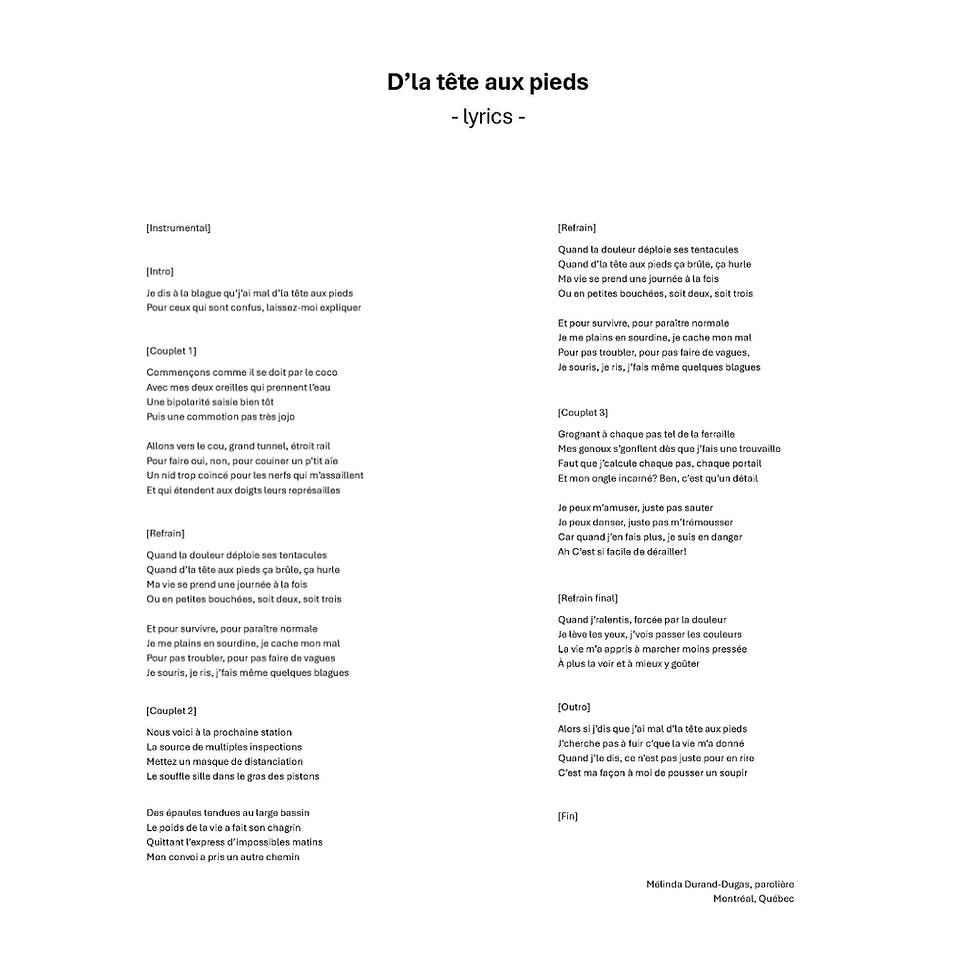
Melinda Durand-Dugas
D’la tête aux pieds — lyrics
Lyrics presented with a clean, minimalist digital layout.
How can pain be shared without overwhelming others or slipping into self-pity? D’la tête aux pieds offers an honest yet humorous response.
Borrowing a familiar French-Canadian expression, the poem takes us on a playful journey through the body, addressing both the personal and social challenges of chronic pain.
While these words later inspired a song and a lyrical video, they are presented here as a complete work in themselves—offering an alternative way of moving through life. A different rhythm. A lighter breath.

Jasmine Eklund
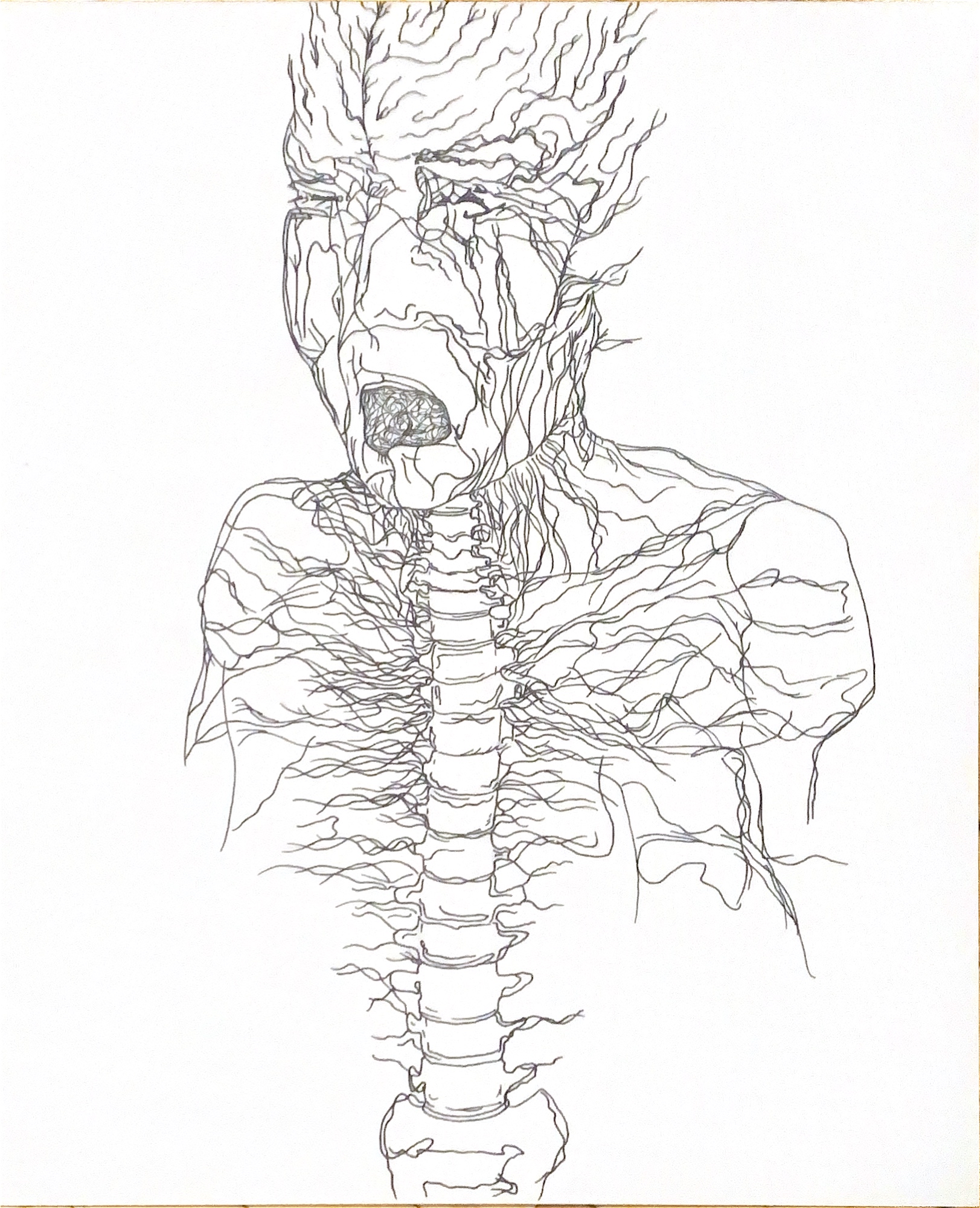
The Weight of Always
Charcoal drawing, with burned tracing paper
You're invited to look closely- not just at the face, but through it, to experience what it's like to live with chronic pain. It speaks to the invisible nature of pain and how much of it is felt internally, even when the outside world can't see it.
It represents how people can feel different types of pain and feel them differently. But, no matter what type of pain they feel, eyes reflect what they are going through. Pain is there in someone's eyes even when there are no other physical signs.

Niama Errafii
The Tortured Torturer
My Medium was oil paint on canvas. I played with lightning and used the classical chiaroscuro technique.
While I’ve struggled with persistent physical pain and a lifelong illness that I was born and still struggle with, my worst pain was from within. We often forget the severity psychological pain, and it’s consequences. I personally used to struggle with self harm. The pain of the cuts were constant but what was even more painful was the addiction and guilt. As part of my recovery, I made this painting that portrays the ruthless cycle, how lonely and painful self harm felt to me. I hope those with similar struggles will be comforted when seeing my artwork, by realizing their not alone in their struggles.

Reilly Fitzgerald
My Theory of Suffering
Acrylic paint on stretched canvas 12” X 9” acrylic on canvas
This is my abstract depiction of mt suffering experience, which in itself is an abstract experience.
The piece is immersed in blackness, but there are segments of colour and elements of starlight seeping through; it is these segments of my life which I must focus on in order to get any relief, distraction, and any sense of purpose in a life that otherwise could drown a person in negativity.

Lisa Kimberly Glickman
Immersed
Acrylic and mixed media on canvas
I try to escape the pain through sleep. Sometimes I feel as though I am underwater..………sleep illudes me

Nadine Hallgrimson
My Mother's Son
Mixed media, acrylic and ink
My brother endured pain for over a year; the bones in his foot breaking down due to diabetes and a severe infection. Following amputation, he is now pain-free. Watching him wheel into Rehab, my heart went heavy; it’s just the two of us now. But somehow, I could feel our mom’s love and warmth pushing us forward through an open door, towards the unknown of what lies ahead for his recovery and future. The number XXIX symbolizes our family past and present and brings us true strength and comfort. Pain has four letters, but so does love.

Dana Hangle
Abstruse
With an 8x10 board and using acrylic paints, photography, my found poem, my drawing, and red string, I constructed, "Abstruse".
The base tones reflect my love of the outdoors. The three photos are of me when I was three years of age. I was fortunate to be born healthy; I was active until 2013. The poem begins by announcing the first hemorrhage in my left thalamus (due to a cavernous angioma), coming home from the hospital, shock, disbelief, chronic pain, and challenges therein. At the bottom, a half skeleton and strings. The strings, a jail motif, are done in red to represent blood. I call this piece, "Abstruse” because Central Pain Syndrome is difficult to understand and address.

Larissa Hauck
It's All In Your Head (Paralysis)
Acrylic painting on canvas
This self-portrait highlights my personal battles with mental illness and the paralyzing anxiety I have fought within myself for longer than I can remember. It was created around a pivotal moment in my healing and represents how anxiety blinds us to reality.

Jonathan Isenor
Rooted
Created by drawing, arcylic painting and some paint markers.
In this piece, I'm the tree clinging to the cliff,and the crashing waves are my chronic pain. The rugged cliffside represents the fractured reality of a body in constant conflict from ankylosing spondylitis. My roots reach deep into the stone, not just to survive the raging storm,but to protect the sanctuaries that keep me whole:The love of my cats,the warmth of my wife and having coffee with her,my love of painting. This painting illustrates that while the waves of pain are relentless,my life is defined by the strength it takes to stay grounded.

Christopher Jackson
Too Little Too Late
Felt, hand drawn. My medium is pen and ink. I order to make this piece hit with maximum impact I took a bold and strong approach.
Men's mental health is an example of silent pain and suffering often resulting in suicide. Its a hidden pain most men suffer from and do not know there is help.

Bahram Jam
Fix My Addiction (FMA)
A poem to pass on the message of compassion for those living with pain & addiction
The video is on the YouTube Link
https://youtu.be/4YakDV4shbE
A poem plus a 3 minute video showing that addiction is an attempt to escape PAIN. No addiction can be "fixed" unless one can truly address the pain.

Ravnoor Kaur
Ignis Fragilitas (Fragility of Fire)
Pastel drawing using soft pastels
My drawing explores how fragile yet resilient our bodies can be and how important it is to appreciate those around us even when we or our loved ones are dealing with pain of any sort; to appreciate and be grateful for the beautiful family and caregivers we have in our lives. The burning butterflies are a symbol of this. Fire represents destruction but metamorphosis. A reminder that sometimes the physical struggles we endure help us and those around us to transform and be better to one another - in some ways reveal the beauty of our enduring and caring souls.

Samantha Kelly
Walking Into The Unknown
This piece was created with watercolour and crayon on white heavyweight cold-pressed watercolour paper.
I feel as though I am in a state of limbo. Of stuckness. The pain is all consuming. It is layered. It creeps. I feel distorted. Numb. Staying here, being consumed by the pain, is not an option. But the path forward is terrifying. It is an abyss of confusion, helplessness, anger, and fear. So much fear. I am afraid to move forward. I take one last look at where I have come from. All the effort and disappointment that has led me here. I don’t want to do this alone. It’s time to get unstuck.

Avery Lee
A Body In Translation
Digital art using Procreate.
This piece explores chronic pain as a personal divide between the body and self. The girl’s unraveling reflects how ongoing pain can quietly reshape a person from the inside, isolating them in ways others may never see. Within that breaking is also a sense of movement and adaptation, mirroring the daily effort to live alongside discomfort. I wanted this work to speak to the human act of learning to carry pain, and to the quiet courage of those who embrace it, and endure it in silence.

Jessie Li
How Pain Falls inside Me
Watercolor
This painting explores how pain falls inside rather than around us. The mermaid represents a young person experiencing emotions that cannot be escaped. The cloud above her releases rain that seems to sink inward, showing how sadness and stress are absorbed silently. As a creature of water, she feels everything more deeply. Her curled posture suggests self-protection and reflection. The artwork connects emotional pain with mental health, showing that pain does not always crash loudly—it often falls gently and stays.

Jaime Lougheed
Harmony in Chaos: The Colors of Chronic Pain
Handmade, acrylic pour
My artwork, "Harmony in Chaos: The Colours of Chronic Pain," is a vivid metaphor for my life with chronic pain, shared with my twin 10-year-olds who face their own health struggles. The swirling reds, blues, and whites on the canvas reflect the unpredictable and isolating nature of our pain. Yet, amidst the darker hues, lighter tones suggest hope, capturing fleeting moments of joy and tranquillity. This piece embodies my personal journey and aims to inspire empathy and understanding for those living with chronic conditions, celebrating the resilience we find amid chaos.

Sam McEwan
ALTO
Pen and marker
This was Alto. He was terrifying, horrific and bad. He represented my pain that I beat after many battles.

Tatiana Noël
Exister avec ce qui reste
Dessin a la main avec stylo à dessin technique marron à pointe fine 0,5 pour architecte sur papier de croquis lisse.
La douleur, l'autre partie de vous qui vous colle mais ne disparaît pas par choix ni par soin, accepter les douleurs de la maladie, se relever chaque jour pour dire oui à la vie, oui je me transforme.

Joni Olitch
Pain Can Be…
Acrostic structure, poetic language, reflective and clinical descriptors, explicit shift cue.
This poem explores how pain can feel overwhelming, intrusive, and all-consuming, but also informative and protective. Using descriptive words for both the challenging and helpful aspects of pain, it illustrates how listening to the body can reveal patterns, insights, and guidance. The poem highlights that while pain can dominate attention, it also offers wisdom, signals boundaries, and points toward a more intentional and integrative way of living. It is intended to help health professionals understand the complex, nuanced experience of pain from a first-person perspective.

Lia Pas
Body map
Hand embroidered cotton thread on linen.
I embroidered my myalgic encephalomyeltis/chronic fatigue syndrome (ME/CFS) symptoms—pain, tingling, and tension—on this pale outline of a woman as I experienced them over a period of three months. The colours and textures evoke different degrees of sensation, some strong and thick, others mild and numerous.

Gwyneth Raene Ramas
Detachment: Dissociation
Traditional art with colored pencils
The brain is a fascinating thing. Unwanted sensations can be detached from our body as we all go through this phase of dissociation. It can be both a blessing and a curse.

Justin Sacksner
Carrying Pain, What Remains
Poetry, photography, mixed-media storytelling, narrative medicine, lived-experience reflection
Carrying Pain, What Remains reflects on witnessing my aunt’s life change profoundly through chronic pain. Through poetry and image, the work traces how pain alters time, roles, memory, and the body, not only for the person in pain, but also for those who love them. Set within both clinical and domestic spaces, it captures the quiet endurance, losses, and adaptations that follow, while honoring what persists beyond suffering: care, identity, and presence. The piece challenges pain as a singular symptom, presenting it instead as a lived, relational experience that reshapes life.

Juiena Sagir
What Grows Through Pain
The artwork was initially drawn in pencil, reproduced using a printer, and finalized with colored pencils.
This drawing presents pain as a journey rather than a single moment. Pain begins at the roots, symbolizing deep sources of suffering. Along this path, medications within the roots reflect treatment at different stages, while the nearby surgical instrument represents deeper intervention when needed. Water falling from above symbolizes mercy and relief during hardship. Despite ongoing pain, the flower continues to grow, drawing strength from the struggle itself. In the end, it reaches the light and blooms, showing that through endurance, care, and mercy, pain can give rise to strength and growth.

Tim Salomons
Never Absent Except During Sleep
Collage, employing National Geographic clippings and an old scientific poster.
The piece explores how pain is felt and experienced, using sun imagery to convey the relentless, burning quality of post-amputation pain—described as “never absent except during sleep.” This embodied, inescapable sensation is set against water imagery, which represents opioid analgesia (visualized using OxyContin tablets). Here, relief is felt as submersion or cooling: pain may recede, but at risk of drifting toward deeper states of numbness, where the boundary between rest, unconsciousness, and permanent sleep becomes dangerously thin.

Ilsa Sejean
Poem RELEASE
Original poem
This is an original poem about how living with chronic pain can be very difficult and cause fear and doubt yet also resilience and belief in oneself

Marie-Line Séguin
Résilience
Fil métallique torsadé, perles de rocailles et quartz cerise.
Cet arbre de vie est né d’une dépression suivie d’un déclic : choisir la vie. Incapable d’utiliser ma main droite, j’ai appris à créer de la main gauche. Perle par perle, pas à pas, il est devenu mon premier défi, un geste pour réapprendre à vivre avec la douleur. Les spirales évoquent la croissance et le recommencement. Le blanc symbolise la vulnérabilité et la simplicité retrouvée. Un quartz en son cœur incarne l’amour reçu et l’amour pour soi. Les racines rappellent l’ancrage. Le vase zen représente l’acceptation, où la douleur peut exister sans définir l’identité.

Ana Teodorescu
God please help me
The painting is made with acrylics on canvas.
This painting shows different approaches to suffering as different paths on a mountain. The protagonist suffers in a hole at the base of the mountain, asks God for help, struggles to climb, and at the top experiences bliss.
Several options are proposed to lighten the suffering. The rower represents courage, the Tai Chi adept represents balance, the dancers represent grace, and the sleeping monk represents faith. The edelweiss symbolizes purity and the snowdrop purity. The dove transforms into the Holy Spirit as the protagonist experiences bliss, emphasizing our true potential, encouraging faith and hope for the next cycle.

Brittney Teuber
Cats Have Nine Lives
Art drawing using micro pigment ink, and alcohol markers
We as people discover pain in various magnitudes throughout our lives. Like cats, pain will come and go as it pleases, will linger, and at times become overbearing as it nuzzles in the comfort of our hearts, minds, and space. Like cats, we fit the idiom of having nine lives; that through all our pain, we are resilient. No matter what vices we consume to numb or void the pain, it stays with us. The cats represent our past and present pain, as they wade our inner peace we strive for.

Carole Thivierge
Sortir de l'ombre
Art numérique abstrait fait avec ArtRage
Ma famille que je ne vois plus à cause de douleurs chroniques très sévères.

Reynold Thomas
Transcendence
Photograph
This image reflects pain as an internal, shifting experience—felt deeply, yet difficult to articulate. The blurred motion suggests the way pain disrupts clarity, distorts time, and unsettles one’s sense of self. The hand moving across the face evokes both protection and overwhelm, a gesture of coping when words fall short. Pain here is not fixed or visible in a single moment; it trembles, lingers, and resurfaces unpredictably. The obscured features speak to isolation and misrecognition, how pain is often unseen or misunderstood by others. Together, the softness and tension embody the vulnerability, resilience, and quiet endurance that define how we feel pain.

Bonnie Thompson
Sifting through Sunrise
Painting on cotton paper with watercolor, watercolor ink with a touch of salt.
How we feel pain: In the morning, I sift through the overactive nerve endings, each one is lit up, ready for attention, and ready to go. It can be sensory overload. It feels like wires inside my head are sparking and shorting out.

Roshanak Vesali
When Everyone Has Left the Funeral
Digital Photography; Captured on iPhone XS Max.
Captured shortly after the funeral, this photograph reflects how pain is felt when rituals conclude, voices fade, and absence remains present through memory and reflection. In the quiet courtyard of a family home, a man sits beneath a tree, posture lowered, looking down at his shadow extending forward. The space is empty, yet shaped by years of shared presence that now exist only in memory. Sometimes pain is not meant to be solved or overcome, but experienced, carried, and quietly lived with over time.
Photograph taken in October 2020.

Sandra Woods
Circuit Overload
Watercolour painting on cotton-paper, using gemstone/mineral pigments; Garnet, Rhodonite, and Cobalt Turquoise for contrast.
How We Feel Pain is through the brain!
In chronic pain, pain signals often continue long after a pain-triggering event has ended; with malfunctions in receiving, interpreting, or responding to pain signals.
The chronic pain brain is like a home's electrical panel in 'Circuit Overload' - flickering lights, frequently tripped circuit breakers, overheating outlets, burning smells, buzzing sounds, and more.
Imagine the brain as an electrical panel overwhelmed by pain; neurotransmitters' signals flicker, dim, overheat, or trip like circuit breakers, leaving the person feeling that different functions of their brain have been disconnected like puzzle pieces pulled apart.



Submission Categories
You can submit your art to one of three categories; Scientific visualizations (e.g. MRI, microscopy), Classical art forms (e.g. drawing, short poem/story), or Photography, video, and music.
Prizes
The top 20 entries from all categories combined, as determined by our Art Awards Jury, will be showcased in printed format during our Annual Scientific Meeting in Québec. Explore previous submissions!
Voting
Voting for this year's winners is up to our Canadian Pain Society members! Voting is open from April 1st to May 1st. Not a member yet?
Share your Masterpiece
Upload requirements
-
Label the file with only the artist's full name (eg.SarahJohnson).
-
Keep submission size below 25 MB.
-
One entry per artist.
-
Familiarize yourself with our submission guidelines.
When photographing art:
-
Clear Photo Composition: Make sure your area is free of obstructions.
-
Optimal Lighting: The photo is well-lit and free of shadows.
-
Thoughtful Cropping: Take a moment to crop your photo, focusing on the main subject and eliminating any distracting background elements.
Digital
-
Ensure a minimum resolution of 300 DPI for high-quality printing.
Video
-
If applicable, please include any trigger warnings for flashing lights, startling sound effects, etc.
-
Please designate and upload a thumbnail for use to display your work on layouts that do not allow for video.